
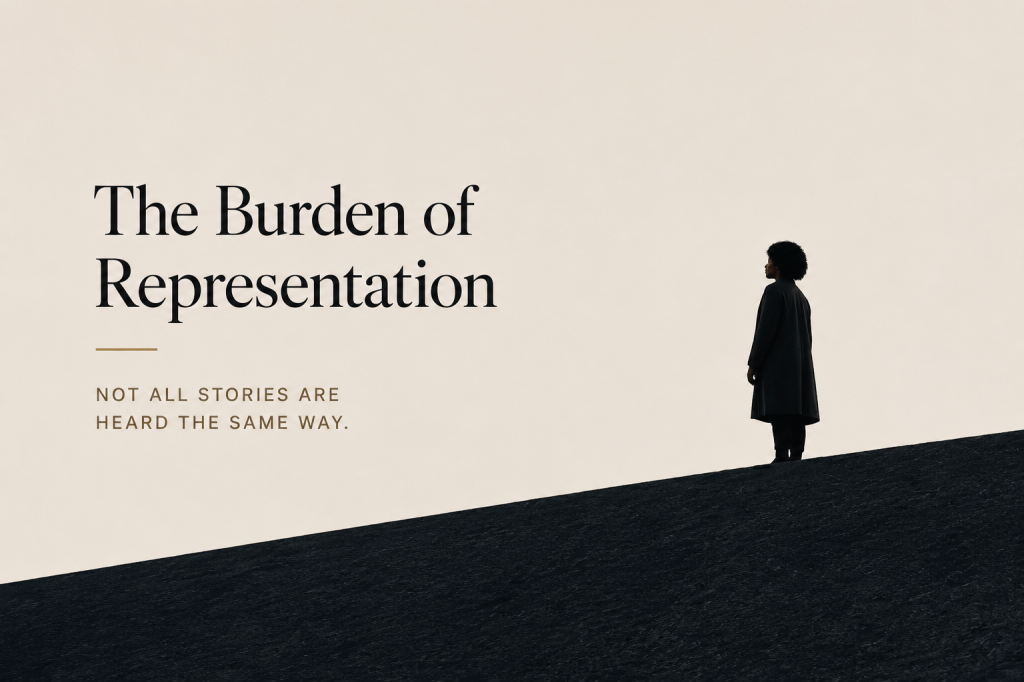
This week, I was listening to NPR’s Code Switch episode, “In college admissions, trauma is shorthand for Blackness,” where sociologist Aya Waller-Bey discussed the emotional tax behind college admission essays. An idea that stayed with me was not only how stories are shaped by the people interacting with them, but also the cost some people carry when sharing their stories.
The cost doesn’t only occur when someone chooses to share something personal. It also shows up in how people are interpreted in situations they did not create, conversations they did not initiate, and events they are simply associated with. In those moments, meaning is assigned, and individuals can be expected to represent something larger than themselves.
There is a burden of representation. Some people get to tell a story and have it remain their own. For others, sharing a story or simply finding themselves inside one can turn them into evidence about an entire group. This isn’t happenstance. Who experiences this pattern isn’t random, and the consequences can be harmful.
It’s something I grapple with as I consider how much of myself feels safe to share, and where I should draw a line between authenticity and reinforcing broader, potentially harmful, narratives.
The Weight of Disclosure
When I first began sharing my story, I did so openly. I offered complete access without considering the consequences, motivated by the sincere desire to open a door for others to see me and build a bridge toward experiences beyond their own. I was unfilteredly genuine. My voice trembled. My eyes watered. I formed deep connections with people.
Over time, I was invited into more spaces to share parts of myself, and for years, I did so willingly. I focused almost entirely on the good that storytelling could create: connection, understanding, recognition, empathy. I never considered the risks that could accompany being deeply seen until those risks began to surface.
And they arrived quietly at first.
They appeared when the room fell silent, when eyes drifted away from me toward others with raised eyebrows, when a facilitator felt the need to emphasize confidentiality in a way that suddenly made me keenly aware that I had disclosed something more precarious than I realized.
They showed up again when I retold my story in different settings and the reactions shifted from profound connection to awkward silence. Over time, I began to notice that the same story could produce entirely different reactions depending on the room. In some spaces, it created connection. In others, discomfort. Silence. Distance. Interpretation.
I realized that I had overlooked certain risks for years, and I don’t do this anymore. I don’t offer myself so freely. Instead, I make a calculated decision every time I share something personal about myself.
For some people, sharing a story is not simply an act of expression. It becomes an act of calculation. And I am not alone in this calculation.
For those aware of the burden of representation, as I am now, sharing is not simple. There is an awareness that others may take our stories as evidence of something larger: a community, a culture, an identity, or a perceived pattern.
This creates a different relationship to storytelling, one capable of reshaping our sense of safety and control. One shaped less by openness and more by anticipation.
This is where the work becomes personal because while some are afforded the ability to speak casually about hardship, conflict, failure, or vulnerability without feeling responsible for what those experiences might imply about others who share their identity, others learn to anticipate interpretation before they even begin speaking.
We self-edit, contextualize, soften, pre-explain, or carefully frame experiences in ways that reduce the risk of reinforcing harmful narratives. Not because the experience is untrue, but because stories do not enter neutral spaces, and the outcomes can be emotionally, socially, and professionally costly.
This internal negotiation echoes what W. E. B. Du Bois described as double consciousness: the experience of anticipating oneself through the eyes of others while navigating the tension between self-perception and external interpretation.
I now understand that our stories enter rooms shaped by pre-existing assumptions, dominant narratives, and unequal interpretive standards. And this awareness creates a form of emotional and cognitive exhaustion that only some carry.
The labor then becomes not only surviving an experience, but also in deciding whether it feels safe to share, how much detail to include, what context must accompany it, and whether the story will still belong to the speaker once others begin assigning meaning to it.
There is a double bind in play. Withholding a story can feel dishonest or distancing, while sharing it can feel risky in ways that extend beyond the individual.
The burden of representation can make authenticity feel conditional.
It can create an awareness that some people are afforded complexity, contradiction, and individuality, while others feel pressure to remain legible, careful, or exceptional in order to avoid becoming symbolic.
And over time, that awareness can begin to shape not only what is shared, but how someone experiences themselves before the story is ever spoken aloud.
Filtering through Dominant Narratives
When we hear stories, we don’t hear them in a vacuum. We hear them through pre-existing stereotypes and dominant narratives that, in turn, determine whether we see someone as an individual or as representative of a larger group.
The experiences shared by Black, Brown, and other non-dominant groups are more likely to be interpreted as evidence of a broader group reality. In contrast, experiences shared by individuals from the dominant group, such as white men, are more likely to be understood as personal, contextual, and not indicative of a larger pattern.
The same story does not move through the world in the same way for everyone.
This asymmetry becomes visible across multiple areas of public and personal life, and I’m going to highlight just a few examples to show how expansive this truly is.
Mass Shootings in the United States reveal how different group identity is activated depending on who commits harm. When white perpetrators commit acts of mass violence, media coverage often centers on individual explanations: mental health, isolation, personal grievance, family history, or psychological instability. Their actions are typically framed as tragic, individualized, and disconnected from whiteness as a broader social identity or group pattern.
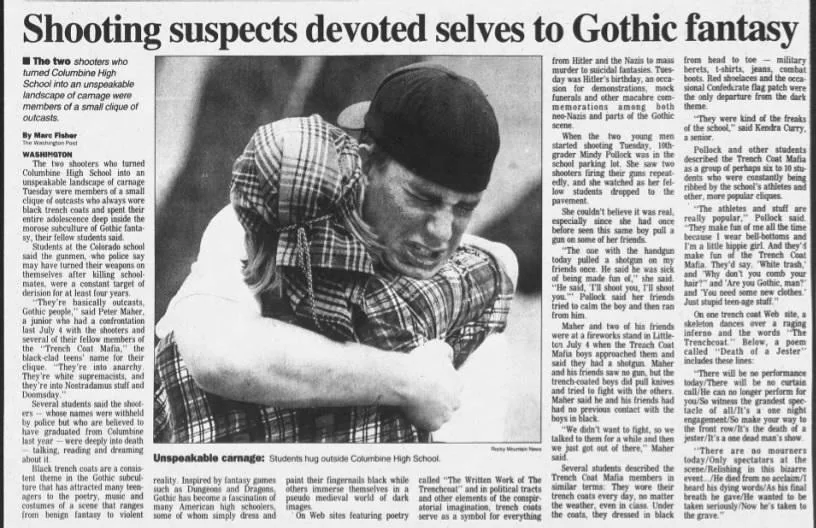
In contrast, when violence is committed by individuals perceived to belong to non-dominant groups, the act is more likely to activate a broader narrative about the group itself. Following the September 11 attacks, for example, millions of Muslims and people perceived to be Arab experienced heightened scrutiny, suspicion, and pressure to publicly condemn the violence they had no connection to personally.
This dynamic appeared again in public discourse surrounding the 2015 killing of Kate Steinle. During his 2016 presidential campaign, Donald Trump repeatedly invoked Steinle’s death as part of broader messaging around undocumented immigration and border security. The actions of one undocumented immigrant became symbolically tied to larger narratives about immigrants as a group, reinforcing public perceptions that extended far beyond the individual case.
The difference is not simply the act itself, but in how representation functions. Some people are more readily granted individuality even in wrongdoing, while others become symbolically tied to a larger collective identity.
These patterns do not only shape public discourse after large-scale events. They also appear in ordinary interpersonal interactions, where individuals from non-dominant groups can be subtly repositioned as representatives of something larger than themselves.
Below is an example of how the burden of representation plays out at a personal level. Fashion blogger and writer Hoda Katebi appeared on WGN News in 2017 to discuss her blog JooJoo Azad and Tehran street style. Within minutes, the host pivoted from fashion to asking questions about Iran’s nuclear program.
Moments like this helped me recognize how quickly individuality can disappear once someone is read as representing something larger than themselves.
This pattern extends far beyond media coverage or public events.
It shows up when a Black student writes a college admission essay about their experience living in a low-income household and how that experience is often interpreted as representative of a broader reality. In contrast, when a white student shares a similar experience, it is more likely to be heard as a personal circumstance, not a reflection of a larger group, allowing dominant narratives to remain undisturbed.
It shows up when an immigrant family’s need for public assistance becomes interpreted as evidence of a broader group reality and used to reinforce narratives about the burden immigrants bring, while a non-immigrant family’s need for the same support is more likely to be understood as situational and specific to that household.
It shows up when a bilingual employee speaks with an accent and is more likely to have their competence questioned, while multilingualism in other contexts is celebrated as intelligence, sophistication, or global awareness.
It shows up over and over again, across both public and interpersonal life.
The Mechanisms that Divide
This pattern does not emerge in isolation. Multiple social and cognitive mechanisms reinforce it, shaping how stories are interpreted, generalized, and remembered.
One of the strongest influences is the power of dominant narratives: the cultural stories, assumptions, and scripts that shape how societies interpret identity, behavior, belonging, and who is seen as credible. These narratives influence whose experiences are treated as individual and whose are treated as representative.
When a story from a non-dominant group aligns with existing stereotypes, it is more likely to be interpreted as confirmation of a broader truth. When it contradicts them, it is often dismissed as an exception rather than something capable of disrupting the underlying narrative.
The homogeneity effect further reinforces this divide. People tend to view groups outside their own as more uniform and internally similar, while viewing their own group as diverse, nuanced, and made up of individuals. As a result, people from non-dominant groups are more likely to have their actions interpreted collectively, while people from dominant groups are more often granted individuality and separation from the larger group.
This dynamic can also appear in smaller interpersonal ways, such as when people repeatedly mistake individuals from another racial or ethnic group for one another while more easily distinguishing members of their own group. This reflects the tendency to process out-group members more categorically and with less perceived individuality.
Fundamental attribution error shapes these interpretations as well. People often explain behavior through perceived personal characteristics while overlooking structural or situational context. This becomes visible when a Black woman receiving public assistance is more likely to be associated with stereotypes about laziness or dependence, while white recipients are more often granted explanations rooted in hardship, circumstance, or economic instability.
Confirmation bias helps sustain these patterns over time. People are more likely to notice, remember, and reinforce stories that confirm pre-existing beliefs while minimizing contradictory evidence. In this way, stories are not simply heard; they are filtered through expectations that already exist before the story is ever told.
In isolation, these interpretive tendencies may appear subtle or insignificant. But repeated across institutions, media, workplaces, classrooms, and interpersonal interactions, they begin to shape broader social realities. Over time, they influence who is seen as credible, competent, dangerous, trustworthy, sympathetic, or representative.
Repeated over time, these interpretations shape whose experiences are individualized, whose identities become symbolic, and who is granted the benefit of complexity and separation from collective judgment.
Some people are allowed to have experiences. Others are treated as evidence.
The same story told by a Black woman may land differently in a room of white colleagues than in a room with people who share her experience. The room matters because stories are interpreted through the assumptions, experiences, and dominant narratives listeners already carry with them.
These asymmetries shape more than interpersonal perception. They influence whose mistakes are seen as individual failings and whose mistakes become cultural evidence, who is granted the benefit of the doubt, and who must continually prove they are separate from the narratives attached to their identity.
The Consequences of Representation
These dynamics also shape how accountability functions socially. When someone from a dominant group causes harm, their actions are more likely to remain attached to the individual. Their behavior is contextualized, individualized, and separated from the larger group they belong to.
For those within dominant groups, this becomes a form of protection. The harm is more likely to remain attached to the individual rather than expand outward into judgment about the larger group. When someone outside that group causes harm, it is more likely to be absorbed into a broader narrative about the group itself—evidence, stereotype, judgment, and at worst, retaliation.
This distinction matters because individuality itself functions as a form of social protection. The ability to be seen as separate from a larger group identity creates distance from collective scrutiny and collective blame.
The result becomes both burden and protection: burdening non-dominant groups with representation while protecting dominant groups from collective accountability.
This is something I have become increasingly aware of whenever a large act of violence or public harm dominates public conversation. I immediately wonder how the person responsible will be publicly identified because I know certain communities will inevitably absorb suspicion, scrutiny, and consequences that extend far beyond the individual involved.
The Power of Storytelling: The Counter-Narrative
And while dominant narratives can flatten people into symbols, storytelling also has the ability to interrupt that process.
A counter-narrative does not comfortably conform to the dominant script. It complicates it. It disrupts the instinct to generalize and challenges the idea that one story, one experience, or one stereotype can adequately explain an entire group of people.
Counter-narratives expand what is possible to see. They make it harder to collapse people into symbols by introducing contradiction, nuance, individuality, and complexity. The more dimensionality we allow people to have, the more difficult it becomes to interpret them solely through inherited assumptions or pre-existing narratives.
A counter-narrative can be as simple as an immigrant family describing their migration not because they were fleeing violence, poverty, or instability, but because they simply chose to move. We can highlight Asian American artists who exist outside the narrow scripts often assigned to them—scripts that prioritize math, science, technical skill, or professional achievement over creativity, emotional complexity, or artistic expression.
The more stories I encountered that resisted familiar scripts, the more I realized how narrow many dominant narratives had always been.
This is part of why storytelling continues to matter, even within unequal systems of interpretation. Not because every story will be interpreted fairly, or because vulnerability is without risk, but because expanding the range of stories we hear can weaken the illusion that any one narrative fully defines a group of people.
Counter-narratives cannot fully erase dominant narratives, but they can create friction against them. They can interrupt certainty, complicate assumptions, and widen the boundaries of who gets to be seen as fully human, contradictory, nuanced, and individual.
Reframing Interpretation
People from non-dominant groups carry a representational burden: their individual experiences are more likely to be interpreted as evidence about their entire group. Yet that burden does not only live in what is shared or who shares it. It also lives in how stories are interpreted, what assumptions are attached to them, and what others ask those stories to represent.
This requires reflection not only from the speaker, but from the listener as well. Interpretation is shaped by the narratives, stereotypes, and assumptions people already carry with them before a story is ever told.
Part of resisting this dynamic requires becoming more aware of how interpretation is happening in everyday interactions.
Notice how stories are being interpreted.
When we hear someone’s experience, it is worth paying attention to how quickly broader meaning begins attaching itself to the story. Are we treating it as one person’s account, or as evidence about an entire group? Are we allowing complexity, contradiction, and individuality to remain intact, or are we unconsciously filtering the story through pre-existing narratives and expectations? Sometimes the shift from individual to representative happens so quickly that we barely notice it happening.
Resist the urge to generalize.
Especially when a story aligns with an existing stereotype, it can become easy to mistake familiarity for representativeness. But alignment alone does not make a story definitive, nor does a single experience fully explain a community, identity, or culture. The stories that feel most confirming are often the ones we are least likely to question, which is part of why dominant narratives can become so deeply reinforced over time.
Hold complexity without forcing symbolic meaning.
Not every story needs to confirm or disrupt a larger narrative. Sometimes it is simply one person’s experience. The pressure to extract broader meaning from every story can flatten people into symbols rather than allowing them to remain individuals with contradictory, incomplete, and deeply personal lives.
Be mindful of what we ask others to carry.
This requires paying attention to the invisible expectations placed on different people when they share their experiences. Some people are expected not only to share their experiences, but to explain, defend, contextualize, or symbolically represent something larger than themselves in the process. Over time, that expectation can quietly reshape how safely someone feels speaking at all.
Create space for multiple stories.
No single story can fully represent a community, identity, or lived experience. Expanding the range of stories we hear matters more than deciding what any one story ultimately “means.” The more stories we allow ourselves to encounter, especially those that complicate familiar assumptions, the more difficult it becomes to reduce entire groups of people into singular narratives.
I still believe storytelling matters wholeheartedly. I also realize that each story carries a different weight depending on the bearer and the room. We may speak hoping to be understood. Hoping to establish that thread of human connection. Yet that hope often comes with a calculation, one that begins before we speak and sometimes before we even walk into the room.
Reflective Questions
- Who gets to be seen as “neutral,” and who is always read through a lens?
- When does sharing lived experience become unintentionally reinforcing a stereotype?
- What does it take for a system or a room to hold a story without generalizing it?
- When was the last time you encountered a story that challenged a narrative you previously held?
Further Reading
- Chimamanda Ngozi Adichie: The Danger of a Single Story | TED (19.16m)
- Langston Hughes, “The Negro Artist and the Racial Mountain”
- Caste by Isabel Wilkerson
- Read: Perception Institute, “Telling Our Own Story”
Until next time, Azucena.

