
Diversity, equality, equity, inclusion, belonging, and justice. These words are often used interchangeably, but they are not the same thing. The distinctions matter. Each one points to a different question, a different challenge, and a different lever for change.
As we navigate conversations around identity, opportunity, fairness, and social systems, it’s helpful to begin with a shared understanding of these foundational concepts. We must not only understand each concept individually, but also how they relate to one another.
Together, these ideas help us understand who is present, who has access, who can participate, how people experience that participation, and how systems can be designed to create fair outcomes.
Diversity
Diversity is the presence of a wide range of identities, backgrounds, experiences, and characteristics within a group, organization, or community. These identities can include, but are not limited to, race, ethnicity, gender, sexual orientation, age, ability, neurodiversity, religion, socioeconomic status, national origin, language, and more.
It is important to understand that diversity exists at the group level. A single individual cannot be “diverse.” While individuals possess multiple identities, perspectives, and lived experiences, diversity refers to the variety that exists across a collection of people.
For example, hiring one woman into an otherwise all-male workplace does not make that individual “diverse.” Rather, her presence contributes to the overall diversity of the group. Similarly, a classroom, team, neighborhood, or organization may be more or less diverse depending on the range of identities and experiences represented within it.
Diversity describes who is present. It does not tell us how people are treated, whether opportunities are distributed fairly, whether people feel valued, or whether systems produce equitable outcomes. Those questions are addressed by other concepts, including equity, inclusion, belonging, and justice.
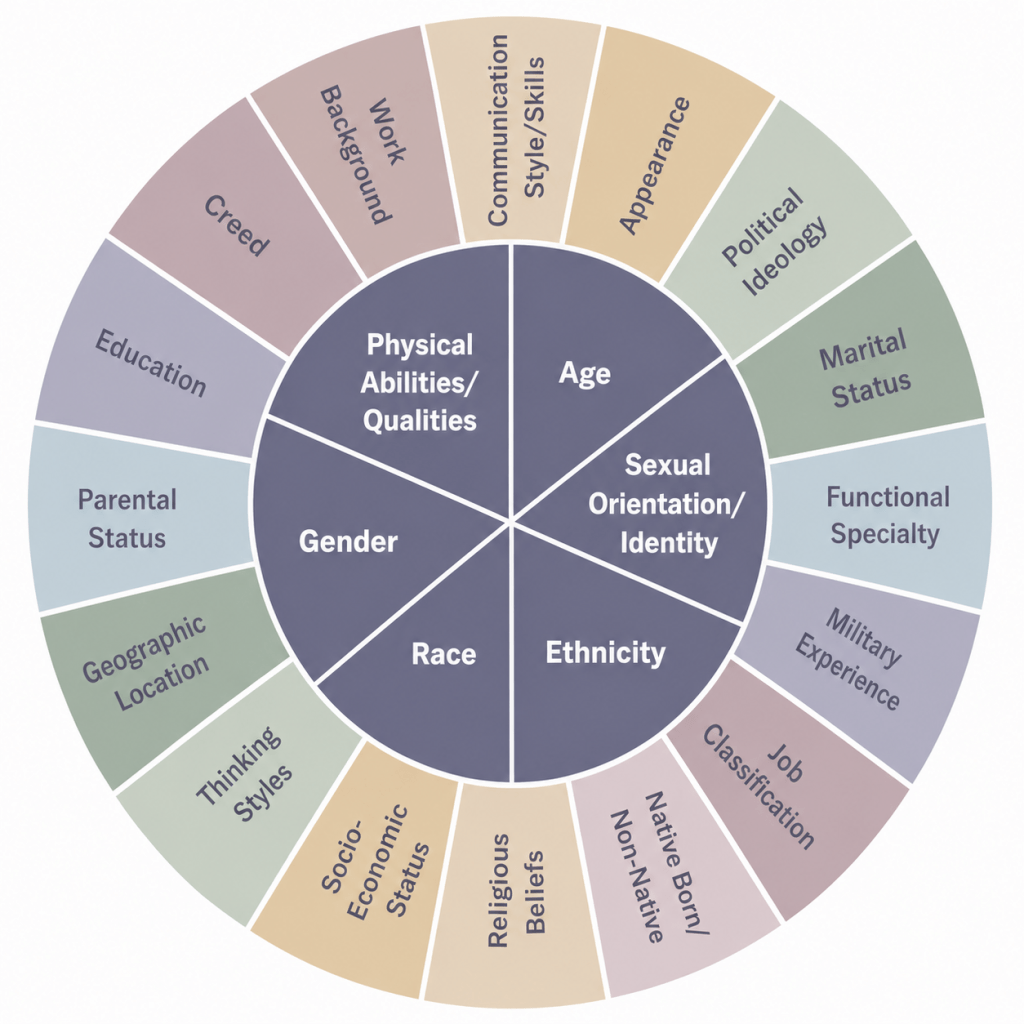
Dimensions of Identity and Experience: These dimensions help shape individual experiences and perspectives. When a variety of identities and experiences are represented across a group, diversity emerges.
Diversity broadens the range of perspectives, experiences, and knowledge available within a group. It can influence how problems are understood, how decisions are made, and whose needs are considered.
The next question is whether everyone who is present has equal access to opportunity.
The following two concepts are often referenced interchangeably, but they are distinct ideas. At first glance, they may even appear to pursue the same goal. However, equality and equity start from different assumptions about fairness, leading to very different approaches for addressing access, opportunity, and systemic barriers.
Equality

Equality is the principle that everyone should receive the same opportunities, resources, rights, or treatment. The idea is straightforward: if everyone receives the same thing, everyone has a fair chance to succeed.
At its core, equality focuses on consistency, and at first glance, this approach may seem fair. However, it overlooks context. In reality, people do not all begin from the same place. Individuals and communities experience different barriers, advantages, histories, and circumstances. When those differences are ignored, providing everyone with the same resources does not necessarily create fairness; it can simply produce different outcomes.
Equality describes giving everyone the same thing.
To illustrate this, imagine giving everyone in a room the same pair of shoes: size 6 lace-up boots. Everyone receives the exact same resource. On paper, the distribution is equal. But what if someone wears a size 8 shoe? What if someone has limited dexterity and cannot easily tie the laces?
Equity is how we respond to those differences in context.
Equity

Equity brings context into the conversation. It recognizes that giving everyone the same thing does not necessarily create fairness because people do not all begin from the same place. Individuals and communities experience different barriers, advantages, histories, and circumstances that shape their ability to access opportunities and resources. Essentially, equity is concerned with giving everyone a shoe that fits.
Because equity acknowledges these differences, it requires us to identify and address the barriers that prevent people from fully participating and succeeding. The goal is not equal distribution, but fair access and fair opportunity.
Equity is the fair distribution of resources, opportunities, and support according to what people actually need.
In practice, equity can take many forms. It may mean providing information in multiple languages so that people can access and understand it. It may mean offering different levels of academic support based on a student’s individual needs rather than assigning every student the same amount of tutoring. It may mean sharing meeting materials in advance so that people who process information differently have time to reflect and prepare before participating in a discussion.
In each case, the goal is not to give everyone the exact same thing. The goal is to ensure that people have a fair opportunity to access, participate, and succeed.
Equality vs Equity: Addressing the Starting Line
A race on a running track can help illustrate the difference between equality and equity. At first glance, fairness might seem to mean placing every runner on the exact same starting line. Everyone would be treated the same, and it might appear that they have the same opportunity to win the race.
However, once we consider the design of the track, additional context emerges. Because the track curves, runners in the outer lanes would have to travel a greater distance than runners in the inner lanes if everyone started from the same line. Although the starting positions would be equal, the race itself would not be fair.
To address this, the starting lines are staggered. Runners in the outer lanes begin farther ahead so that every runner covers the same total distance. The goal is not to give some runners an advantage, but to account for the design of the track and create a fair opportunity for all competitors.
This illustrates an important distinction between equality and equity. Equality focuses on giving everyone the same starting position. Equity recognizes that different circumstances sometimes require different adjustments to create a level playing field. In both cases, the goal is fairness, but the approach is different.

If equity focuses on creating fair access and opportunity, the next two concepts focus on what happens once people arrive. Inclusion and belonging are often discussed together because both influence how people experience participation within a group. However, they are distinct ideas: one focuses on creating the opportunity to participate, while the other focuses on how participation is experienced.
Inclusion
Inclusion refers to the practice of creating environments where people of different backgrounds, identities, experiences, and abilities can fully participate and contribute.
Inclusion opens the door.
It is the proactive removal of barriers that limit participation by building systems, practices, and opportunities that allow everyone to engage, contribute, and be heard.
Many acts of equity promote inclusion. When meeting materials and discussion topics are shared in advance, individuals who need time to process information have an opportunity to prepare their thoughts before participating. Making outreach materials available in large print and multiple languages expands access for a broader range of community members. Adding closed captioning and ensuring documents are compatible with screen readers removes barriers for people with different accessibility needs. Seeking community input during evening hours, providing virtual participation options, or offering multiple ways to engage can make participation possible for people who might otherwise be excluded.
Each of these actions helps create the conditions for meaningful participation and, therefore, inclusion. Simply being present is not the same as being able to participate.
Belonging
While inclusion creates the opportunity to participate, belonging reflects how people experience that participation.
Belonging is feeling welcome once you walk through the door.
It is the feeling of being accepted, valued, and connected within a group or community. It means being able to show up as yourself and knowing that who you are, what you bring, and what you contribute matter. Belonging fosters trust, connection, psychological safety, and a sense of shared purpose.
Belonging is the goal of inclusion.
Belonging can also influence how people choose to participate. It can mean feeling comfortable enough to share an idea that has not yet been raised, provide context others may not be aware of, or volunteer for a project because there is confidence that their input will genuinely be considered.
More importantly, belonging can reduce an often unseen emotional burden. It lessens the hypervigilance some people experience when they feel they must constantly assess whether it is safe to speak, contribute, disagree, or be themselves. Instead of spending energy evaluating risk, people can focus that energy on participating, collaborating, and contributing.
Additionally, when people do not experience belonging, they may begin to withdraw, remain silent, or disengage altogether. When belonging is present, participation becomes more natural, authentic, and sustainable.
While belonging helps us understand how people experience a system, justice asks why those experiences exist in the first place.
Justice
Justice goes deeper and looks for the root causes of injustice and inequity. It refers to the creation of systems, policies, and structures that are fair by design. Instead of focusing on helping people navigate barriers, justice seeks to identify and address the conditions that created those barriers in the first place.
It is also one of the most challenging concepts to put into practice. Diversity, equality, equity, inclusion, and belonging often focus on how people experience and navigate existing systems. Justice asks who built those systems, who benefits from them as they are, and what would need to change for the answer to be different. Those questions are uncomfortable by design.
Justice shifts the focus from individual outcomes to systemic change. It asks why inequities exist, who benefits from existing arrangements, and how systems can be redesigned so that equitable outcomes are built into the structure itself rather than achieved through ongoing intervention.
Put another way, equity helps people navigate an uneven path. Justice works to level the path.
Examples of justice can be seen all around us. Blind resume screening removes information that can introduce unconscious bias into hiring decisions. Curb ramps and accessible pedestrian crossings make public spaces usable for people with a wide range of mobility and accessibility needs. Accessibility standards in buildings, websites, and public services help ensure that inclusion is built into the design rather than added later as an accommodation.
Justice is not simply about responding to barriers after they appear. It is about designing systems that are less likely to create them in the first place.
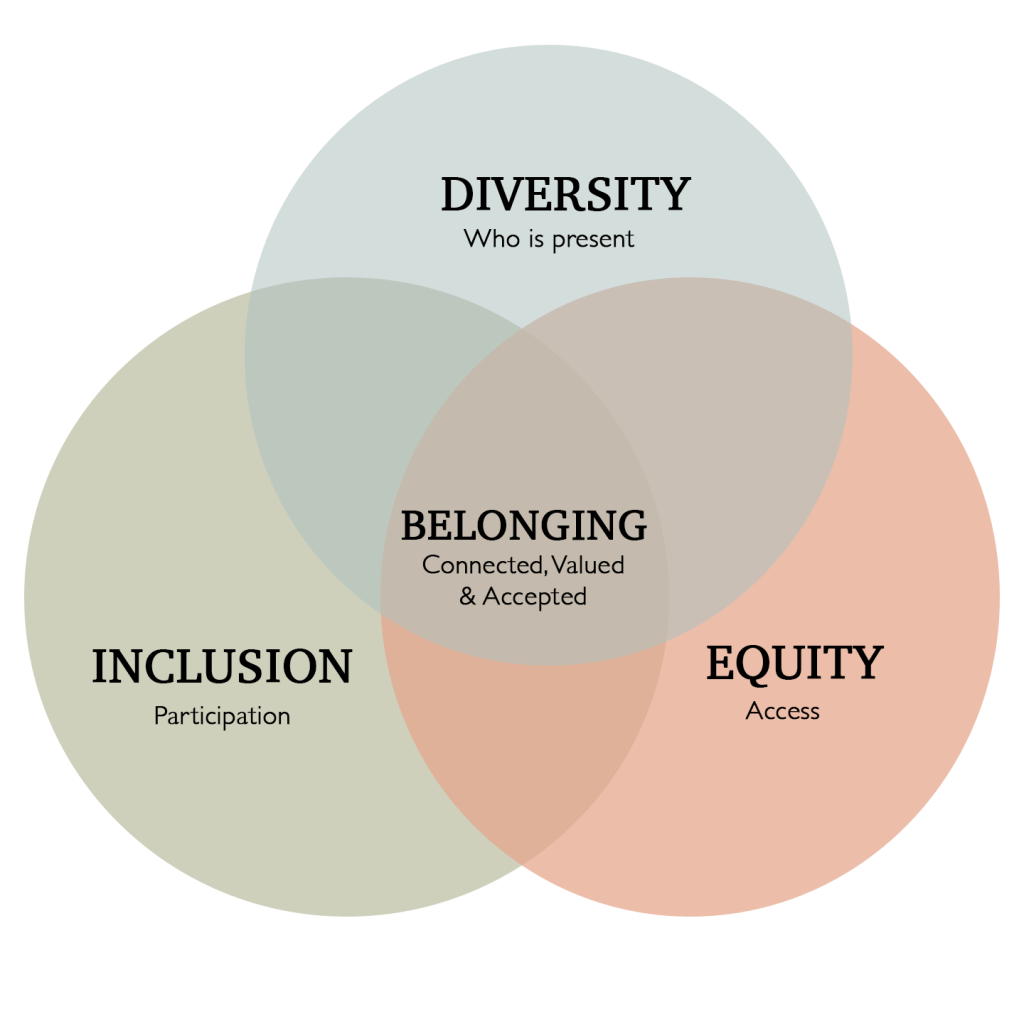
While these concepts are closely connected, each serves a different purpose. Together, they help us understand who is present, who has access, who can participate, how people experience that participation, and how systems can be designed to create fair outcomes.
At a glance:
- Diversity: Identifies who is present.
- Equality: Gives everyone the same resources, opportunities, and treatment.
- Equity: Ensures people have what they need to access opportunities fairly.
- Inclusion: Creates opportunities for meaningful participation.
- Belonging: A sense of feeling accepted, valued, and connected.
- Justice: Addresses root causes by designing systems that are fair by design.
These concepts are more than vocabulary. They are tools that sharpen our understanding of how the world around us works. Each highlights a different aspect of how people experience systems, opportunities, and communities. The better we understand what each one is asking us to notice, the more clearly we can identify challenges, understand experiences, and choose meaningful paths toward change.
Until next time friends,
Azucena

